
The Hume Body Pod is a home smart scale with foot electrodes and a handheld sensor bar. It records body weight and uses bioelectrical impedance analysis (BIA) to estimate body fat, fat mass, muscle-related values, water, and segmental measurements.
That makes it more detailed than a basic weight-only scale. It does not make every number a clinical measurement.
Purchase and referral disclosure: The GLPSpot owner purchased the Hume Body Pod with personal funds; it was not gifted or supplied as a review unit. This Hume Body Pod link is a referral link, so we may receive a referral benefit if you purchase through it. We have not performed our own DXA comparison. Product features, prices, and referral terms can change; confirm the current offer at checkout.
Quick verdict
The Hume Body Pod is most useful for someone who wants:
- body weight recorded automatically in an app;
- repeated estimates from the same device;
- a handheld eight-electrode format rather than foot-to-foot BIA alone;
- segmental estimates for the arms, legs, and trunk;
- more context than a single bathroom-scale number.
It is not a replacement for:
- DXA or another clinician-selected body-composition assessment;
- strength or functional testing;
- evaluation of rapid weakness, poor intake, dehydration, or falls;
- individualized nutrition or medication decisions.
The right way to use it during GLP-1 treatment is to watch longer trends under similar measurement conditions. Do not change medication, calories, protein intake, or exercise based on one app reading.
What the Hume Body Pod measures
Hume currently describes the product as a dual-frequency body-composition scale with four weight sensors, a handheld sensor bar, Bluetooth connectivity, and 45 displayed body-composition measurements. The company lists a weight range of 9 to 400 pounds and a rechargeable battery.[1]
The free Hume app can display weight and body measurements over time. Hume says Premium is not required to use the scale, while nutrition tracking, coaching, personalized insights, and some weekly reporting sit in its paid plan.[1]
The long metric list needs context. Weight comes from the scale's load cells. Body fat, fat mass, muscle, visceral fat, body water, metabolic age, and related values are estimates produced from electrical impedance plus profile information and Hume's model. Forty-five outputs do not represent 45 independent laboratory tests.
What the app looks like in actual use
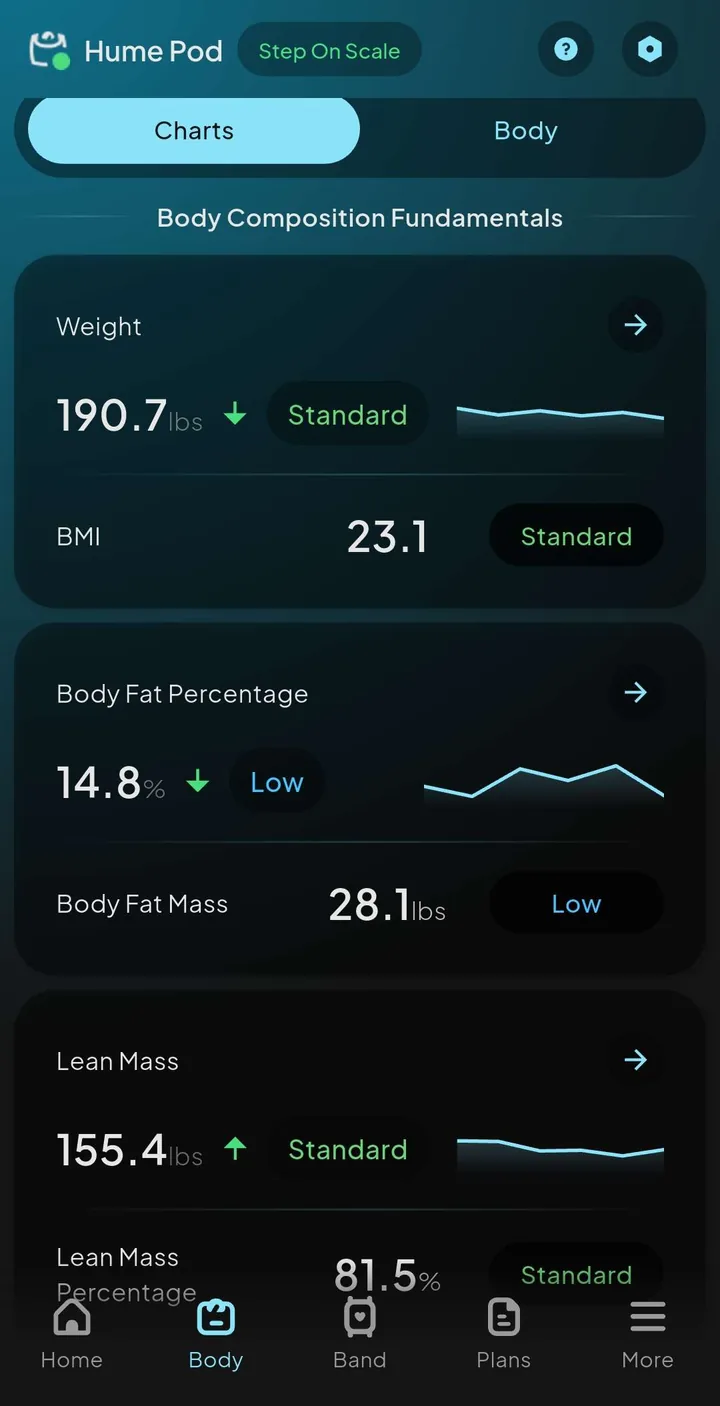
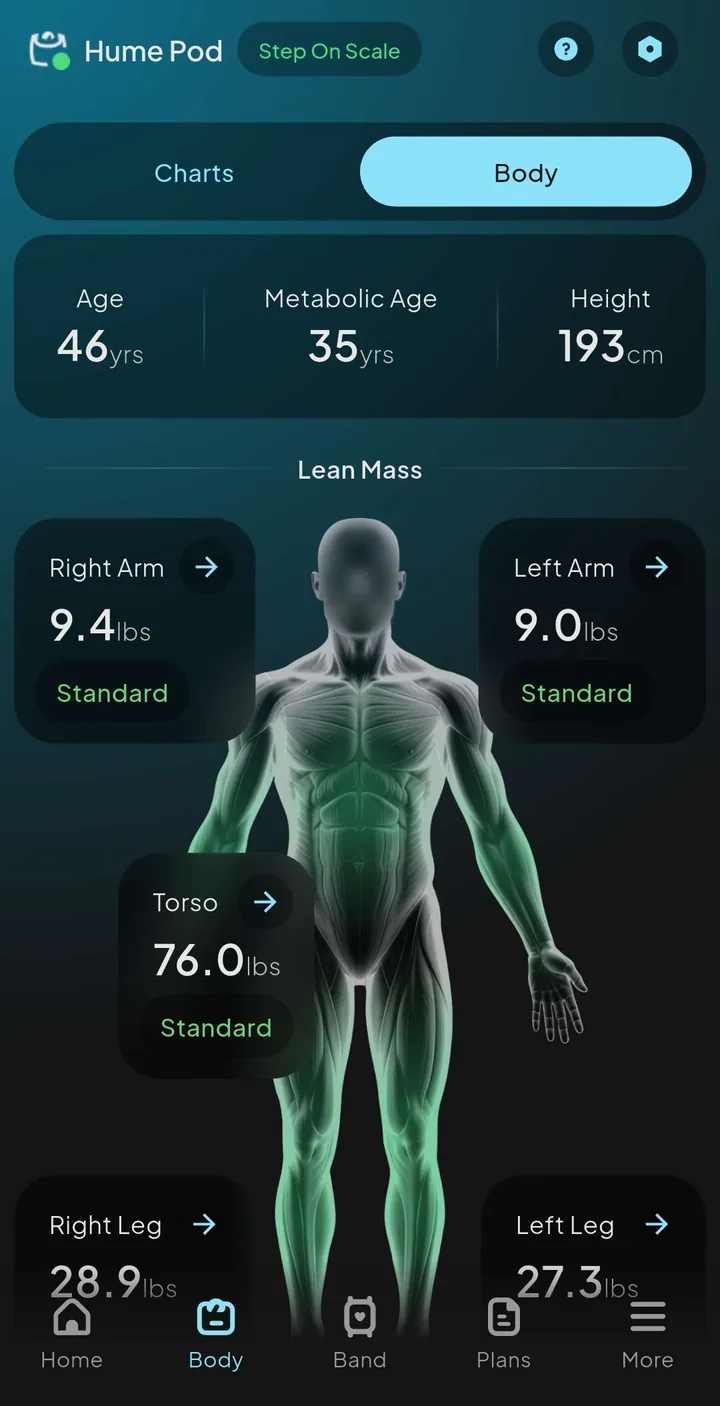
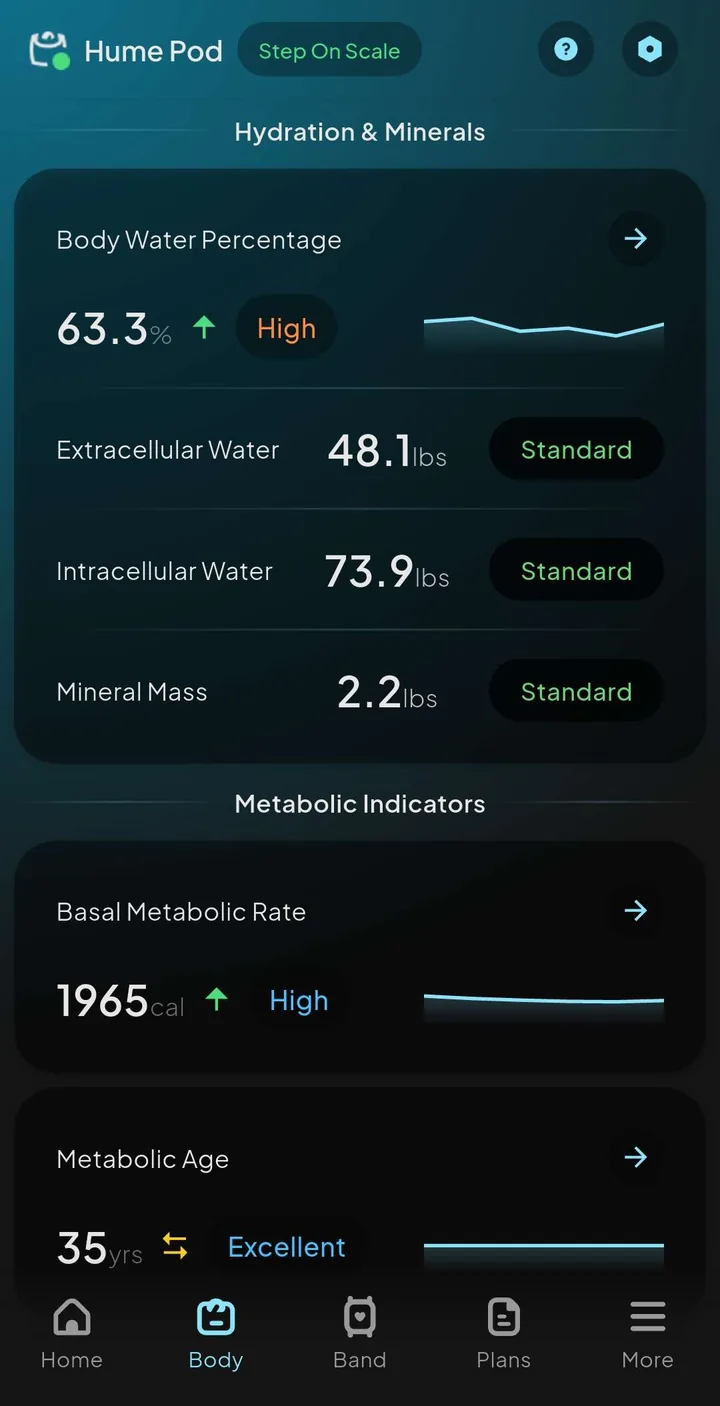
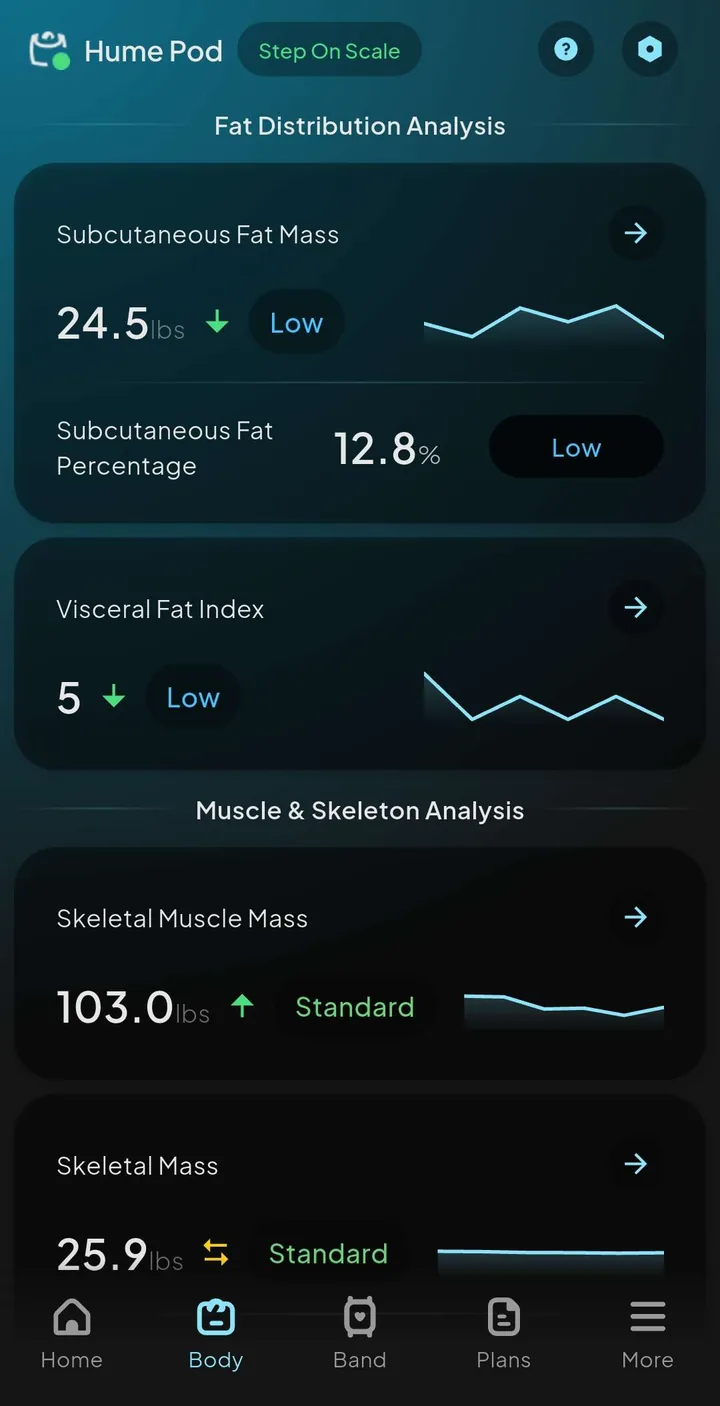
These screenshots are from the GLPSpot owner's Hume app after using the Body Pod. They show how the app organizes readings and short trend lines. The exact values are personal app readings, not medical targets or typical results, and the body-composition figures remain BIA estimates.
Why this can matter during GLP-1 treatment
Weight alone cannot show whether a change came from fat, lean tissue, water, or normal day-to-day variation. That is one reason people taking Wegovy (semaglutide), Zepbound (tirzepatide), or another GLP-1-based medication may want more than a basic scale.
The Body Pod can add a repeatable home data stream. A gradual trend in its estimated fat or fat-free mass may provide context alongside:
- body weight;
- waist measurement;
- strength and physical function;
- food and protein intake;
- resistance-training progress;
- symptoms such as persistent weakness or dizziness.
The scale cannot confirm that a change labeled "muscle" represents skeletal-muscle tissue. Fat-free mass includes water and other non-fat tissue. Hydration, recent food, exercise, skin temperature, and contact with the electrodes can change a BIA estimate without an equivalent biological change.
Our DXA versus smart-scale guide explains why results from the two methods should not be used interchangeably.
What the Hume-specific validation found
A Texas Tech University research group posted a Hume Pod validation preprint in July 2026. The study included 67 adults who completed duplicate Hume assessments during one controlled laboratory visit along with DXA and a four-compartment reference assessment.[3]
Repeatability
The preprint reported intraclass correlation coefficients of at least 0.993 for body-fat percentage, fat mass, and fat-free mass during duplicate same-visit tests. Technical errors were 0.8 percentage points for body-fat percentage and 0.6 kg for fat mass and fat-free mass.[3]
That supports strong short-term repeatability under controlled conditions. It does not establish the size of day-to-day variation in an ordinary home environment.
Agreement with the four-compartment model
Hume estimates were statistically equivalent to the study's four-compartment estimates at the group level within the authors' predefined equivalence regions. Mean absolute errors were 2.6 percentage points for body-fat percentage and 1.9 kg for both fat mass and fat-free mass.[3]
Agreement at the group level does not mean every individual reading fell within those amounts. The reported limits of agreement were wider than the mean errors.
Comparison with DXA
The DXA comparison was more mixed. Hume's body-fat percentage averaged 27.1%, compared with 28.9% by DXA. The two body-fat-percentage methods were not statistically equivalent under the study's predefined test, although correlation remained strong and the mean absolute error was 3.0 percentage points.[3]
This is why "98% accurate compared with DXA" is too simple. Accuracy can refer to correlation, average error, equivalence, or individual agreement, and those are not the same result.
Important limitations
The study:
- is a preprint and has not been certified by peer review;
- included 67 adults from one local community;
- tested duplicate measurements during one controlled visit;
- used fasting, hydration, activity, and measurement protocols that differ from ordinary home use;
- excluded some populations, including people with a pacemaker or electrical implant and people who were pregnant or breastfeeding;
- did not test whether following the app improves GLP-1 treatment outcomes.
The paper states that Hume did not fund the project and that the lead author's laboratory had not received support from Hume.[3]
What broader smart-scale research says
A 2021 peer-reviewed study evaluated three other consumer smart scales against DXA. Weight measurements were reasonably accurate, but body-fat and muscle estimates showed larger errors; the authors concluded that those scales should not replace DXA in patient care.[4]
That study did not test the Hume Body Pod, so its exact errors should not be assigned to Hume. It supports a broader caution: an accurate weight reading does not automatically validate every body-composition output.
The newer Hume-specific preprint is more favorable than the results for those older scales, especially against the four-compartment model. The evidence is still early, and no home scale should diagnose muscle loss or replace a clinically indicated assessment.
How to get more consistent trends
Hume's setup instructions call for a hard, flat surface, bare feet, Bluetooth connection, and holding the sensor bar while standing upright.[1]
For more comparable readings:
- Use the same scale and user profile.
- Keep the device on the same hard, level surface.
- Measure at a similar time of day.
- Keep the relationship to food, fluids, exercise, bathing, and sleep similar.
- Use clean, dry electrode contact as directed.
- Watch a multi-week pattern rather than one reading.
Do not dehydrate, skip meals, or alter medication to make a measurement look more consistent.
Free app versus Hume Plus
Hume says the free app supports weighing and viewing body measurements. Its product page currently lists paid features such as nutrition planning and tracking, personalized coaching, and weekly reports; it also displays a monthly Premium price.[1]
Treat app pricing and feature boundaries as changeable. Check the current product page and in-app subscription screen before purchasing. The scale should make sense for you based on the free measurement features unless you already know you want the paid coaching layer.
Returns and warranty details
Hume advertises a 45-day trial and a standard one-year warranty on the current product page.[1]
The separate returns policy adds conditions that matter: the device must be in its original packaging and in like-new condition, the purchase must have been made directly from Hume, and customers generally pay return shipping unless the product is proven defective.[2]
Before ordering:
- read the current return policy rather than relying on a promotional badge;
- keep the packaging during the trial period;
- confirm whether a referral promotion changes return eligibility;
- save the order confirmation;
- review any optional extended-warranty charge separately.
Who may find it useful
The Body Pod may fit someone who:
- likes frequent home measurements;
- understands that body-composition outputs are estimates;
- can use consistent measurement conditions;
- wants automatic app history;
- prefers a handle-and-foot-electrode design;
- will also track strength, function, nutrition, and symptoms.
A basic Bluetooth weight scale may be enough if you only need a reliable weight trend. A clinical assessment may be more appropriate when a clinician needs a controlled estimate that could change treatment.
Who should check before using it
Follow Hume's current safety instructions. The validation preprint excluded people with pacemakers or electrical implants, and the broader DXA versus smart-scale guide explains why manufacturer warnings matter for BIA devices.[3]
Ask a clinician or the device manufacturer before use if you have an implanted electronic device, are pregnant, or have another condition covered by product-specific warnings. Do not rely on a consumer scale to evaluate edema, dehydration, osteoporosis, sarcopenia, or another diagnosis.
Using the Hume Body Pod without overreacting
A useful weekly review might include:
- the weight trend rather than the lowest reading;
- the direction of body-fat and fat-free-mass estimates over several weeks;
- whether hydration-related outputs moved sharply;
- changes in strength or daily function;
- difficulty meeting nutrition goals;
- symptoms worth discussing with a clinician.
A sudden one-day change in body fat or muscle is more likely to reflect fluid and model variation than an equivalent overnight tissue change. Recheck under normal, consistent conditions instead of changing your routine to chase the number.
Bottom line
The Hume Body Pod offers a more detailed home BIA setup than a basic foot-only smart scale. Early independent preprint evidence found strong short-term repeatability and favorable agreement with a four-compartment model, but DXA body-fat equivalence was not established and the paper has not been peer reviewed.[3]
For GLP-1 tracking, its best role is trend monitoring. Weight, estimated fat and fat-free mass, strength, function, nutrition, and symptoms should be considered together. The device cannot diagnose muscle loss or determine treatment changes.
If that fits your expectations, you can check the current Hume Body Pod referral offer here. Referral terms, price, app features, and return conditions should be verified before purchase.
This article is informational and does not replace medical advice. Do not change medication, diet, fluid intake, or exercise based on a consumer-scale reading without appropriate clinical guidance.
Hero image: official Hume Body Pod product image, used for product identification. Source: Hume Health.