Weight loss can trigger temporary hair shedding called telogen effluvium, particularly after marked weight loss or extreme dieting. It often appears a few months after the trigger. Eating adequately, addressing any underlying deficiency, and getting the cause checked are more useful starting points than buying a hair-growth supplement. There is no guaranteed way to prevent shedding, and not every case of hair loss after weight loss is temporary.[1][2][3]
This guide covers weight loss from diet changes, bariatric surgery, and medication. For the separate question of medication-specific risk, see our Wegovy and GLP-1 hair-loss research guide.
Why hair can start shedding after weight loss
Hair follicles normally move through growth and resting phases. A major physical change can shift more follicles into the resting phase, followed by shedding. Dermatologists call this telogen effluvium. Marked weight loss, extreme dieting, illness, and surgery are recognized triggers; several can happen together.[1]
Eating too few calories or not getting enough protein or iron can also contribute to hair loss. But shedding does not automatically mean you have an iron deficiency, and taking extra nutrients without knowing the cause is not a substitute for an assessment.[3]
The pattern matters. Telogen effluvium usually causes shedding across the scalp rather than isolated bald patches. Inherited pattern hair loss can occur at the same time, so a recent change on the scale does not explain every change in your hair.[1][2]
There is no proven weight-loss cutoff that predicts shedding
A 2024 retrospective study examined 140 patients already diagnosed with weight-loss-associated telogen effluvium. Their average weight loss was about 15% of body weight. That was a description of selected patients, not a threshold below which hair loss cannot happen.[5]
The study did not enroll everyone trying to lose weight, so it cannot tell us what percentage of dieters will develop shedding. It also cannot establish a weight-loss speed that guarantees hair protection. Do not use its averages as a target or a prediction of your own risk.[5]
When shedding starts and how long regrowth takes
Shedding can be delayed, and less shedding is not the same as restored thickness. The British Association of Dermatologists says telogen effluvium can appear around three months after a trigger. That delay is why hair changes may become noticeable after the period of fastest weight loss has passed.[1]
| Stage | What the guidance describes |
|---|---|
| Trigger to noticeable shedding | Often a few months; timing varies.[1][2] |
| Active shedding | Commonly three to six months in temporary telogen effluvium.[1] |
| Return of fullness | The AAD describes fullness often returning within six to nine months as the body readjusts; some people need longer.[2] |
| Shedding beyond six months | Considered chronic telogen effluvium if that diagnosis is confirmed; reassessment is appropriate.[1] |
These are general ranges, not a promise of recovery by a particular date. An ongoing trigger or an untreated condition can prolong shedding. You do not have to wait six months to ask for help.[1][2]
What may help reduce avoidable hair loss during weight loss
Avoid extreme restriction and get help if eating is difficult
The AAD identifies too few calories and insufficient protein or iron as possible contributors to hair loss. A balanced eating pattern is more useful than trying to find one food that will stop shedding.[3]
If reduced appetite means you regularly skip meals or struggle to eat enough, bring that to your clinician or registered dietitian. Ask them to assess your intake and weight trajectory. This article does not prescribe a calorie minimum or a universal protein target; individual needs and medical conditions differ.
For practical food ideas, our meal prep guide for smaller appetites can help with planning. If you use a powder because food intake is difficult, the protein-supplement label guide explains how to compare products. Neither a powder nor a particular protein intake guarantees hair regrowth.
Check the cause before adding iron or other supplements
A clinician can review the timing, examine your scalp, and decide whether blood tests are appropriate. Depending on the history and findings, testing may look for causes such as iron deficiency or thyroid problems. Not everyone needs the same panel.[1][6]
Treating an identified deficiency is different from taking a high-dose hair supplement just in case. The AAD cautions that excess amounts of some nutrients, including selenium and vitamins A and E, have been linked to hair loss.[3]
Protect fragile hair without expecting hair care to fix the trigger
Gentle brushing, limiting heat and chemical treatments, and avoiding tight hairstyles can reduce additional damage. These steps do not remove an internal trigger for telogen effluvium, but they can keep breakage and traction from adding to the problem.[1][3]
A volumizing shampoo or camouflage fibres can change how thin hair looks. They do not establish that the underlying shedding has stopped.[1]
Biotin, collagen, hair vitamins, and minoxidil
A supplement advertised for hair growth is not automatically a treatment for weight-loss-related shedding. NIH says there is little scientific evidence supporting biotin's hair, skin, and nail claims, and biotin deficiency is very rare in the United States.[4]
High-dose biotin can also produce misleading results in some laboratory tests, including thyroid tests. Tell your clinician and the laboratory about supplements before testing; ask for instructions rather than choosing your own stopping interval.[4]
The dermatology guidance cited here does not establish collagen supplements as a treatment for weight-loss-associated telogen effluvium. Do not assume that adding collagen or a multi-ingredient hair gummy will correct the cause. If you already take several supplements, bring the labels to your appointment so the clinician can review the combined ingredients.[3][6]
Minoxidil is used for certain types of hair loss, but it is not a universal answer to shedding after weight loss. The British Association of Dermatologists says temporary telogen effluvium normally improves without medication. A dermatologist can determine whether you also have pattern hair loss or another diagnosis that changes the treatment discussion. Do not start a medicine solely on the assumption that your shedding is telogen effluvium.[1][6]
Hair loss after bariatric surgery
Surgery and marked weight loss can both trigger telogen effluvium. After bariatric surgery, nutritional follow-up also matters; the right response is not to replace your surgical team's plan with generic hair vitamins.[1][7]
ASMBS advises ongoing follow-up and lifelong vitamin and mineral supplementation after bariatric surgery, with the amounts directed by the bariatric program. Follow your team's prescribed diet stages and supplement plan, and contact them about new shedding, missed supplements, or difficulty meeting intake goals.[7]
Advice to avoid unnecessary supplements does not mean stopping prescribed bariatric supplements. Tell the team about any additional hair products before combining them with your existing regimen.[3][7]
Hair loss while taking a GLP-1 medication
Do not assume a medicine is the sole cause, and do not stop or reduce it on your own. The AAD recommends discussing suspected medication-related hair loss with the treating clinician because stopping treatment can have consequences.[2]
Our medication-specific hair-loss article covers Wegovy (semaglutide), a GLP-1 medication, and the limits of the research. The practical questions remain whether the pattern fits shedding, whether food intake has changed substantially, and whether another cause needs assessment.[1][2][3]
When to see a clinician or dermatologist
Arrange an assessment if shedding is worrying you, especially if it is persistent or getting worse. Seek an earlier appointment for isolated bald patches, a progressively widening part, a receding hairline, or a painful or visibly inflamed scalp rather than assuming these are ordinary weight-loss shedding. Different hair disorders can require different care.[1][2][6]
Tell your clinician if the weight loss was unintentional, or if hair changes occur with other new symptoms. Weight loss and hair loss can occur alongside an underlying illness; they should not automatically be attributed to dieting.[5][6]
Before the appointment, write down:
- When the weight change began and whether it was intentional.
- When shedding started, and whether it is widespread or in specific areas.
- Recent illness, surgery, major stress, or medication changes.
- What a typical day of eating looks like and whether eating has become difficult.
- Every medicine and supplement you take, including hair gummies and biotin.
These notes help a clinician take a useful history. Avoid repeatedly pulling your hair or counting every strand to try to diagnose yourself.
Common questions about hair loss after weight loss
Can losing weight cause hair loss?
Marked weight loss and extreme dieting can trigger telogen effluvium, a form of diffuse hair shedding. Not all hair loss after weight loss has this cause; nutritional deficiencies, thyroid disease, and other hair disorders may need evaluation.[1][3]
Will hair grow back after weight loss?
Hair often regrows when temporary telogen effluvium settles and its trigger is addressed. Shedding may last three to six months, and restoring fullness can take longer. Pattern hair loss or another diagnosis may require different treatment.[1][2]
How can I prevent hair loss while losing weight?
There is no guaranteed way to prevent shedding. Avoid extreme restriction, maintain adequate nutrition, and discuss persistent difficulty eating or rapid weight changes with your care team. Treat confirmed deficiencies rather than starting a hair-supplement stack.[1][3]
Does biotin stop hair loss after weight loss?
Biotin is not an established treatment for weight-loss-related shedding in people without a deficiency. NIH reports little evidence for hair-growth claims, and high-dose biotin can interfere with some laboratory tests.[4]
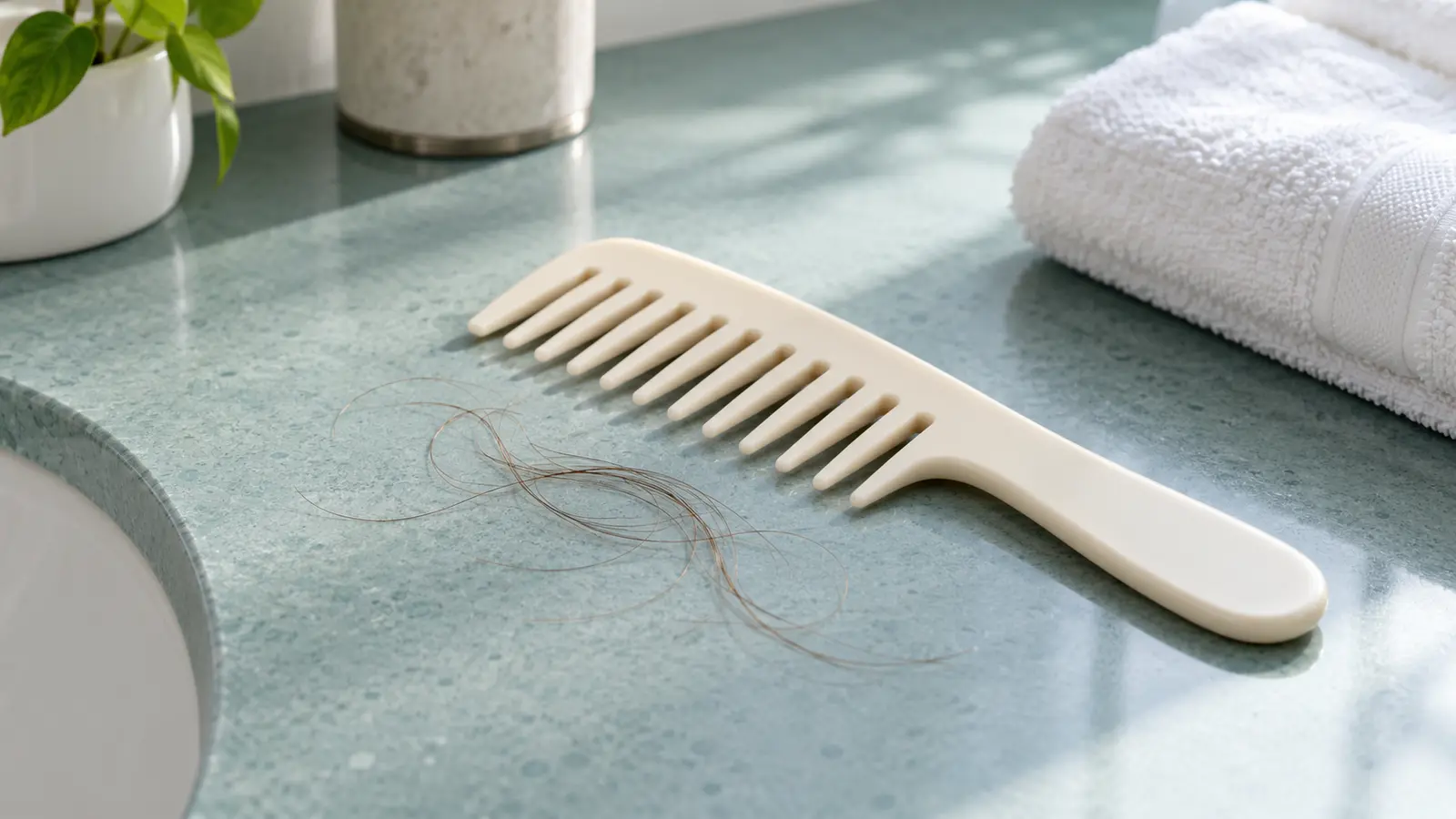
This article is educational and does not diagnose hair loss or replace medical care. Do not change prescription treatment or prescribed bariatric supplements without discussing it with your care team. The hero image is an AI-generated illustration, not a patient photograph or treatment result.
Sources
- [1] bad.org.uk
- [2] aad.org
- [3] aad.org
- [4] ods.od.nih.gov
- [5] pmc.ncbi.nlm.nih.gov
- [6] aad.org
- [7] asmbs.org


