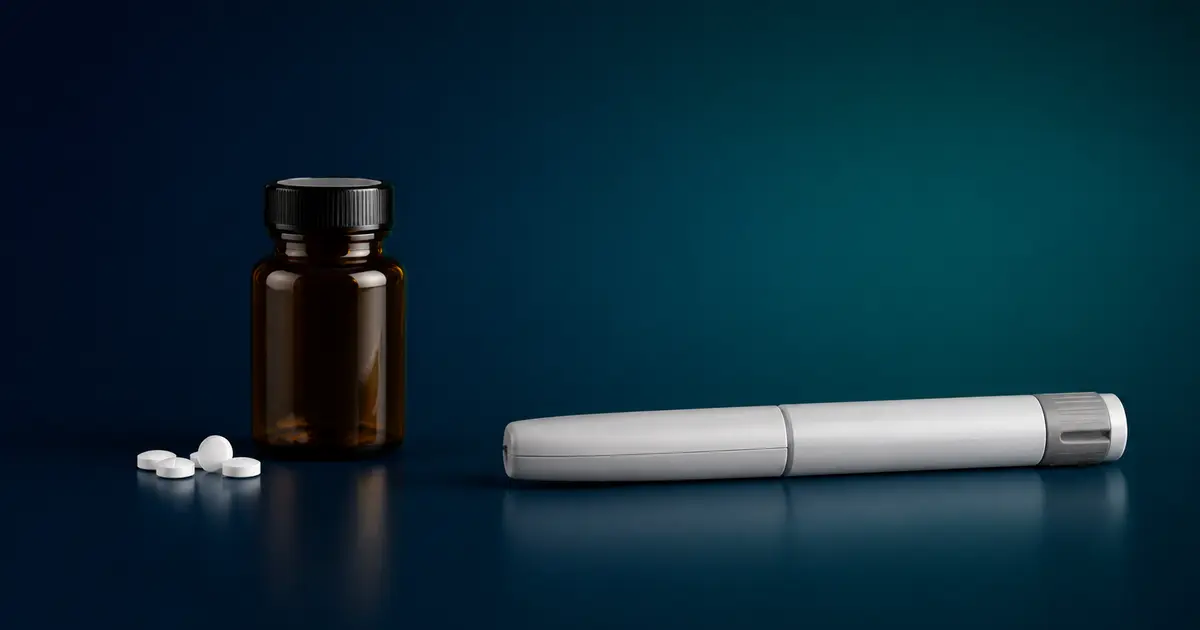
Oral Ozempic is no longer just an informal way to describe Rybelsus. The current FDA labeling includes Ozempic (semaglutide) tablets in 1.5 mg, 4 mg, and 9 mg strengths.
The name can still create confusion because four different products now enter the conversation:
- Ozempic tablets, taken once daily for type 2 diabetes
- Rybelsus tablets, another once-daily oral semaglutide product for type 2 diabetes
- Ozempic injections, taken once weekly for type 2 diabetes
- Wegovy tablets, a separate oral semaglutide product approved for chronic weight management
They contain the same active medication, semaglutide, but that does not make their strengths, indications, or schedules interchangeable.
Quick Comparison
| Feature | Ozempic tablets | Rybelsus tablets | Ozempic injection |
|---|---|---|---|
| Active medication | Semaglutide | Semaglutide | Semaglutide |
| Form | Oral tablet | Oral tablet | Subcutaneous injection |
| Frequency | Once daily | Once daily | Once weekly |
| Available strengths | 1.5 mg, 4 mg, 9 mg | 3 mg, 7 mg, 14 mg | 0.25 mg, 0.5 mg, 1 mg, 2 mg per injection |
| Morning food rule | Empty stomach; wait at least 30 minutes | Empty stomach; wait at least 30 minutes | No label-based empty-stomach rule |
| FDA-approved specifically for chronic weight management | No | No | No |
| Needles | No | No | Yes |
These strengths are product labels, not instructions for choosing or changing a dose. A prescriber determines the appropriate product and regimen.
What Are Ozempic Tablets Approved For?
The FDA label says Ozempic tablets are indicated for adults with type 2 diabetes:
- as an adjunct to diet and exercise to improve blood-sugar control
- to reduce the risk of major cardiovascular events—cardiovascular death, nonfatal heart attack, or nonfatal stroke—in adults at high risk for those events
Ozempic tablets are not FDA-approved specifically for weight loss or chronic weight management. Weight change can occur during diabetes treatment, but that is different from having a weight-management indication.
Oral Wegovy is the semaglutide tablet product with a chronic-weight-management indication. Calling every oral semaglutide product an “Ozempic pill” can therefore lead readers to the wrong indication, strengths, or coverage assumptions.
Ozempic Tablets vs Rybelsus
Ozempic tablets and Rybelsus are both oral semaglutide, but the FDA label treats them as separate products.
Different strengths
Ozempic tablets come in 1.5 mg, 4 mg, and 9 mg strengths. Rybelsus comes in 3 mg, 7 mg, and 14 mg strengths.
A larger number on one tablet does not automatically mean a larger equivalent dose. The prescribing information explicitly states that the products are not substitutable on a milligram-for-milligram basis.
Similar administration routine
The label gives both oral products the same core administration requirements:
- once daily in the morning on an empty stomach
- with water only, up to 4 ounces
- swallow the tablet whole
- wait at least 30 minutes before eating, drinking, or taking another oral medication
Food, non-water beverages, water volume, and the post-dose fasting interval can affect oral semaglutide absorption. Oral semaglutide may also affect the absorption of some other oral medicines. Someone whose morning routine makes these requirements difficult should follow the labeled spacing instructions and discuss other morning medications with the prescriber or pharmacist rather than changing the routine independently.
Switching is label-specific
The label includes specific transitions between Rybelsus and Ozempic tablets after the initiation phase. It also says not to switch between them during that initial phase.
This is not a situation where a patient should compare the printed milligram numbers and calculate an equivalent. Product availability, current treatment stage, blood-sugar response, side effects, and other medications all matter.
Ozempic Tablet vs Ozempic Injection
The tablet and injection share the Ozempic brand and active medication, but they create different routines.
Daily tablet routine
Ozempic tablets avoid needles but require a consistent morning window. The empty-stomach and water limits can matter for people who take other morning medications, work irregular shifts, or eat soon after waking.
Weekly injection routine
Injectable Ozempic is taken once weekly and does not have the tablet's morning food-and-water requirements. It does require injection supplies, safe sharps disposal, and remembering a weekly administration day.
Injectable Ozempic is also indicated to reduce major cardiovascular-event risk in adults with type 2 diabetes and established cardiovascular disease, and to reduce sustained kidney-function decline, end-stage kidney disease, and cardiovascular death in adults with type 2 diabetes and chronic kidney disease. Those defined populations differ from the “high cardiovascular risk” wording in the combined oral-tablet label, so the products should not be assumed to have identical indication language.
Switching is not a simple conversion
The tablet label contains instructions for some transitions from injectable Ozempic, but it does not provide an oral conversion for every injection dose. In particular, the labeled transition language addresses people taking the 0.5 mg injection dose.
That limitation matters. Someone using a different injection dose should not extrapolate from the available table or jump to an oral strength. The prescriber should use the current labels, treatment goals, glucose data, and clinical history to decide whether a switch is appropriate.
Side Effects and Safety Warnings
Because all three products contain semaglutide, their safety concerns overlap.
The oral label lists these among the most common adverse reactions:
- nausea
- abdominal pain
- diarrhea
- decreased appetite
- vomiting
- constipation
The boxed warning concerns thyroid C-cell tumors observed in rodents. Ozempic tablets and Rybelsus are contraindicated in people with a personal or family history of medullary thyroid carcinoma or Multiple Endocrine Neoplasia syndrome type 2. They are also contraindicated in anyone with a prior serious hypersensitivity reaction to semaglutide or to an ingredient in the specific product.
Other important label warnings include:
- acute pancreatitis
- diabetic-retinopathy complications
- hypoglycemia risk when combined with insulin or an insulin secretagogue such as a sulfonylurea
- kidney injury related to dehydration from gastrointestinal symptoms
- severe gastrointestinal reactions; the tablets are not recommended for severe gastroparesis
- serious hypersensitivity reactions
- gallbladder disease
- aspiration risk during general anesthesia or deep sedation
Get emergency medical help immediately for trouble breathing or swallowing, swelling of the face, lips, tongue, or throat, fainting, or severe low blood sugar—especially if the person cannot safely treat themselves. Stop the medicine and contact the prescriber right away for persistent or severe abdominal pain, particularly pain that may radiate to the back. Contact a clinician promptly for persistent vomiting, diarrhea, or inability to keep fluids down because dehydration can cause kidney injury. People taking semaglutide should also tell the anesthesia or procedure team before planned surgery or deep sedation.
Questions to Ask Before Changing Products
A useful prescriber or pharmacist conversation can cover:
- What is the treatment goal: blood-sugar control, cardiovascular-risk reduction, kidney-risk reduction, chronic weight management, or more than one goal?
- Does the product's exact FDA indication match that goal?
- Can the morning empty-stomach routine work consistently with other medications and meals?
- Is the current injection dose one for which the label supplies switching instructions?
- How could insulin, sulfonylureas, or other diabetes medications affect hypoglycemia risk?
- What does the insurance plan cover under the specific product name and indication?
- Which symptoms should prompt a same-day call or urgent evaluation?
The product name matters when checking coverage. A plan may treat Ozempic tablets, Rybelsus, injectable Ozempic, and oral Wegovy differently even though they all contain semaglutide.
Bottom Line
Yes, there is now an Ozempic pill. Ozempic tablets are once-daily oral semaglutide in 1.5 mg, 4 mg, and 9 mg strengths for adults with type 2 diabetes. They are not the same product as oral Wegovy, and they are not approved specifically for chronic weight management.
Ozempic tablets and Rybelsus have similar morning administration rules, but their strengths are not interchangeable milligram for milligram. Injectable Ozempic uses a weekly schedule and has different administration and indication details. Do not switch products or calculate an equivalent dose without the prescriber and current FDA labeling.
Frequently Asked Questions
Is there an Ozempic pill?
Yes. Ozempic tablets are FDA-approved oral semaglutide for adults with type 2 diabetes. The available tablet strengths are 1.5 mg, 4 mg, and 9 mg. This product is distinct from weekly Ozempic injections and from oral Wegovy for weight management.
Are Ozempic tablets approved for weight loss?
No. Ozempic tablets are approved for type 2 diabetes and for reducing major cardiovascular-event risk in certain adults with type 2 diabetes. They are not approved specifically for chronic weight management.
Are Ozempic tablets the same as Rybelsus?
Both are once-daily oral semaglutide products, but their strengths differ and the FDA label says they are not substitutable milligram for milligram. Any transition should follow the current prescribing information and the prescriber's instructions.
How are Ozempic tablets taken?
The FDA label says Ozempic tablets are taken once daily on an empty stomach in the morning with up to 4 ounces of water. The tablet is swallowed whole, followed by at least a 30-minute wait before food, beverages, or other oral medications. Follow the instructions supplied with the prescription.
Can someone switch from an Ozempic injection to an Ozempic tablet?
The FDA label contains specific switching instructions, but they do not cover every injection dose or situation. A prescriber should determine whether and how a transition is appropriate; patients should not calculate an oral equivalent or switch independently.
Related Reading
- Semaglutide News: Ozempic Tablet Launch and Other Updates
- Semaglutide Guide: Ozempic, Wegovy, and Rybelsus
- Wegovy Pill vs Injection
- Wegovy Pill Doses
- First Week on Ozempic


